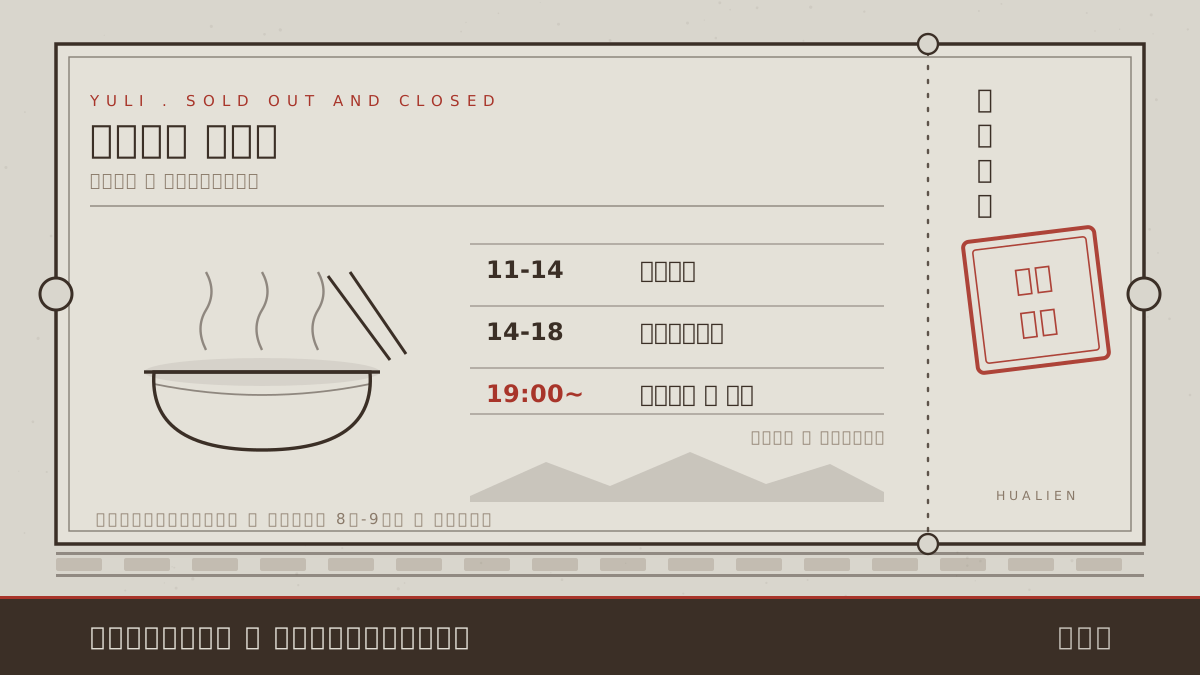
A bowl of Yuli noodles arrives and the fried shallot hits first. Thin noodles, clear broth, a few slices of pork, at a price that has not moved in years.
That bowl is the town’s calling card, and also a metaphor for its schedule: sold out, closed.
The old shops run earlier than you think
Zhongshan and Minguo Road form the main Yuli-noodle block. The well-known shops prepare a set amount, sell it, pull the shutter and go home. Overtime is not a concept here.
So anyone who remembers Yuli noodles after seven in the evening has a high chance of missing out.
The safest plan is lunch, with a second shop in the afternoon. If evening is your only window, call ahead and ask whether any is left — do not drive an hour to end up with instant noodles.
Stinky tofu and the snack stalls follow the same logic: the rhythm tracks daylight.
What is still lit after seven
Plainly, not much. But not nothing.
Chen & Jia Bistro at No. 60-1 Datong Road, Midnight Story Bistro at No. 32, Sec. 2, Ren’ai Road and J.J. Bistro at No. 382 Zhonghua Road are the evening bistros of Yuli. For singing, there is a Holiday KTV at No. 113, Sec. 2, Zhongshan Road.
That density would not register in a west-coast city. In the southern valley it is the entire list. Hours follow on-site notices.
To unwind, Yuxiang Foot Massage at No. 138 Zhongzheng Road and Baihe Foot Massage on Guangming Street are both within walking distance in town.
If you drink, stay off the wheel. Taxi supply is limited and designated drivers are not on tap the way they are downtown — staying somewhere walkable is the practical answer here.
After nine, you can hear the river
Not a figure of speech. The town centre is small; once the shops close and the traffic thins, the ambient sound from the Xiuguluan River side becomes very clear.
Kecheng Iron Bridge and the Yuli Shinto shrine ruins are daytime frames — at night they are simply dark. The shrine ruins off Xibian Street have no lighting, so there is no reason to make the trip.
If what you want is small-town quiet, Yuli delivers in full. If what you want is somewhere to go, adjust first.
The one exception: August to mid-September
The daylily season on Chike Mountain runs roughly August to mid-September, when the slopes above Gaoliao in the Guanyin area turn gold. Paired with sunrise cloud seas, it is the valley’s annual set piece. Mountain guesthouses sell out — book early.
The night part still needs saying: the road is winding, steep and largely unlit. Do not drive it in the dark. Stay on the mountain for sunrise, or come down before nightfall.
For a real night out, an hour either way
TRA Yuli Station is the southern valley’s major stop and most express trains call. North to Hualien City is about an hour, with the night market, the bar strip and massage all in place; south to Taitung City is much the same.
Either beats staying put — but check the last service first. That is where the southern valley catches people out.
On the same valley line, Fenglin and Guangfu share the character: plenty by day, early to bed at night. Treat Yuli as a supply stop rather than a night destination and the trip works.