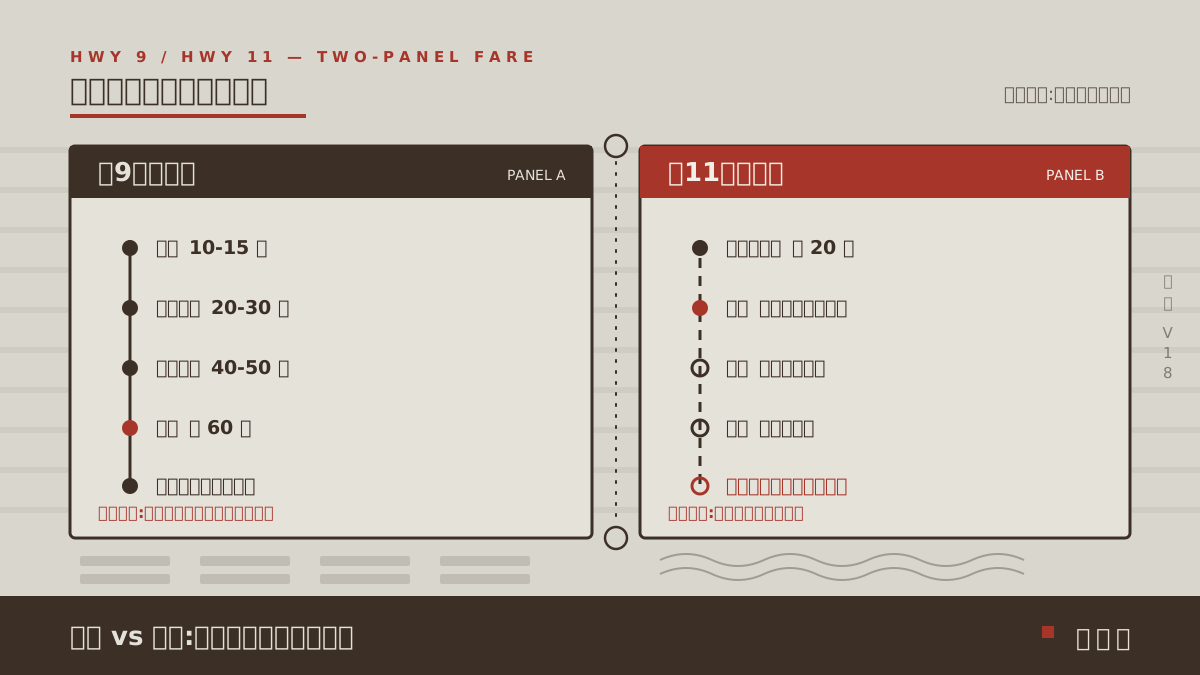
Hualien’s road network is essentially a fork. From Hualien City, two lines run south: Highway 9 inland through the valley, Highway 11 along the ocean.
Both are beautiful by day. After dark, they stop being the same kind of thing.
Open businesses: the valley wins
The valley threads a chain of towns — Shoufeng, Fenglin and Guangfu, Yuli — each with a street grid, a convenience store and a railway station. Even after the small eateries fold at seven or eight, there are still people outside. Yuli’s bistros hold on later than its noodle shops.
The coast south is a different proposition. Past Yanliao in Shoufeng, the stretch through Shuilian and Fengbin has almost no light and nowhere to sit down. The only named venue on the coast road in our listings is 皮爾沙酒吧 (Pizza Bar) at 18 Shanling, Yanliao Village, Shoufeng — and that is still the northern end of Highway 11. Further south it really is just sea and dark.
Road conditions at night: both lose
The valley first. Highway 9 carries fast trucks at night with widely spaced lighting and long unlit runs between towns. Around Shoufeng it’s obvious — once Zhixue Street closes, the road belongs to you and the freight.
The coast is worse. Highway 11 hugs the ocean: dim, curvy, exposed to wind, with poor night visibility and no roadside point to stop for help. Riders should be specifically ready for crosswind.
Neither is “the safer night road.” The only question is which factor gets you: speed on the valley, visibility on the coast.
Distance home: the valley is easier to calculate
The valley has clean mileage. Hualien City to Ji’an is ten to fifteen minutes, to Zhixue twenty to thirty, to Fenglin and Guangfu forty to fifty, to Yuli about an hour. Those numbers go straight into a schedule.
The coast’s problem is that it offers no midway turnaround. Qixingtan to the north is about twenty minutes from the city, which is fine. Heading south past Yanliao, the next real supply point is far away and the return is the same road back.
What you actually see: the coast wins, comfortably
The valley’s night is silence and stars, with firefly season around Liyu Lake in April and May, and the Chike Mountain daylily season in August and September as the valley’s annual set piece — but that one is a daylight programme. The mountain road is steep and winding and should not be driven at night.
The coast’s night is the Pacific: surf that never stops and a sky with no light pollution, which the valley cannot match. If you want it, don’t go far. Head north to Qixingtan instead, where there’s a car park and walkways — keep to the lit area, detail in stargazing at Qixingtan.
Without a car: only the valley has an answer
TRA valley-line trains link Ji’an, Zhixue, Shoufeng, Fenglin, Guangfu and Yuli, so you can move without driving — just check the last service against the day’s timetable.
The southern coast has no railway at all. No car, no trip, charters aside.
The conclusion is boring and correct
Both routes converge on the same sentence: be back in Hualien City before dark.
The valley suits a daytime run with a dusk return. The coast suits a sunset over the ocean and an exit right after. If you genuinely want to linger at night, sleep out there — the trade-offs are in where to stay in Hualien.
And once alcohol is involved, these are two of the worst roads in the county to gamble on. Taxi or designated driver, always. The practical options are in getting home at night in Hualien.